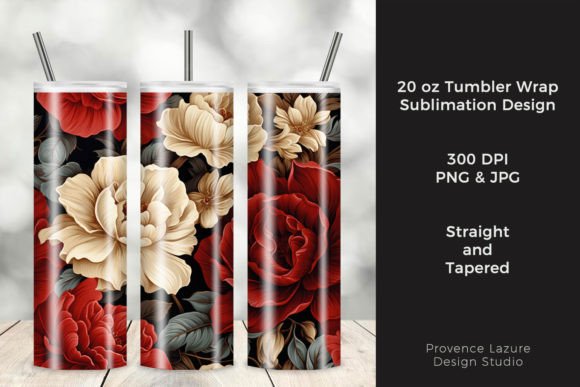
Vintage Red and White Roses Tumbler Wrap
First Impressions: A Quietly Confident Floral Statement
When I opened the Vintage Red and White Roses Tumbler Wrap, what struck me wasn’t flashiness—it was balance. The composition feels intentionally restrained: a soft asymmetrical cascade of roses, some fully bloomed, others in tight bud, with delicate trailing stems and subtle leaf accents. It’s not fussy or over-rendered—no excessive petal layers or hyper-realistic shading. That restraint is its strength. As an embroidery designer who regularly translates graphics into stitch, I immediately saw how this would translate to thread: clean satin-stitch petals, gentle fill-stitch centers, and graceful running-stitch stems that won’t drown in density. It reads as vintage—not dated—and floral—not saccharine. It belongs on a handmade apron more than a glittery phone case.
Real-World Test: From Digital File to Embroidered Tote Bag
Last week, I used the Vintage Red and White Roses Tumbler Wrap as the centerpiece for a linen tote bag destined for a local boutique’s spring collection. Not as a tumbler wrap—no sublimation involved—but as a machine embroidery design scaled to 4.2" wide. Why? Because the layout naturally lends itself to vertical flow, and the rose cluster anchors beautifully along a side seam or centered on a front panel. Customers responded instantly—not just to the flowers, but to the *intentionality*. One buyer said, “It looks like it was drawn for fabric, not slapped onto it.” That’s the sign of a well-considered graphic. In stitching, the design held up across three fabric types: medium-weight cotton duck (crisp and reliable), brushed poly-cotton (slightly softer edges), and lightweight linen (where I added light tear-away stabilizer beneath). No puckering. No thread breaks. Just quiet, confident execution.
Where It Shines—and Where to Pause
The Vintage Red and White Roses Tumbler Wrap excels in projects where elegance meets everyday utility. Think sweatshirt embroidery for a small-batch apparel line, embroidered patches for denim jackets, pillow covers for a cottage-core Etsy shop, or baby embroidery on organic cotton onesies—its soft scale and open negative space prevent visual overwhelm on tiny garments. It also works beautifully on tea towels and aprons, where the floral motif feels grounded, not decorative. For holiday embroidery or wedding gifts, it reads timeless rather than seasonal—pair it with cream thread on charcoal linen for instant sophistication.
But be thoughtful: avoid using it on highly textured fabrics like bouclé or thick terry cloth without testing first—the fine stem lines may blur. On stretchy fabric (like performance knit tees), stabilize aggressively and consider simplifying minor leaf details if your hoop size limits stitch precision. And while the design avoids tiny lettering or micro-details, don’t push it into hoops smaller than 4x4"—the outermost buds and vine tips need breathing room. Also, skip dark fabric unless you’re prepared to adjust thread contrast deliberately; the white roses rely on luminosity, not opacity.
Design Integrity Meets Customer Trust
What makes the Vintage Red and White Roses Tumbler Wrap commercially smart isn’t just prettiness—it’s coherence. When stitched, it reinforces brand consistency for craft businesses: think cohesive nursery decor sets, boutique-branded kitchen towels, or personalized gifts where the design feels like part of a story, not a stock add-on. Buyers notice that. They feel the care in the spacing, the rhythm in the petal placement, the way the white roses pop against red without harsh contrast. That perception lifts perceived value—handmade product buyers pay more for designs that look *designed*, not assembled. It also builds trust: when your Etsy listing shows a clean, well-digitized preview—and the finished product matches—it signals professionalism, not guesswork.
Practical Notes Every Embroidery Designer Should Run Through
- Always test first: Stitch the Vintage Red and White Roses Tumbler Wrap on scrap fabric matching your final project’s weight and stretch.
- Check thread color harmony: The red and white palette is flexible, but test how your chosen red thread reads next to your white—not all “white” threads are equally bright, especially on off-white fabric.
- Review stitch density: While not overly dense, inspect the center blooms—if your machine struggles with tight fill areas, consider lightening density by 5–7% in those zones.
- Confirm hoop compatibility: This isn’t a 1.5" monogram—it’s a statement piece. Ensure your hoop size supports the full width comfortably, especially if placing near seams or curved edges.
- Inspect small details: Zoom in digitally before stitching. Are vine tips crisp? Do leaf veins read clearly at your intended size? If not, simplify manually—or embrace the slight abstraction as part of its vintage charm.
- Mock it both ways: Generate printable mockups on light and dark backgrounds. Does the white rose retain presence on navy? Does the red hold warmth on cream?
- Stabilizer strategy matters: Use cut-away for knits, tear-away for stable wovens, and light fusible for linens. Skip heavy stabilizers—they’ll mute the design’s airiness.
- Licensing clarity is non-negotiable: Remember: this is a digital embroidery file derived from a sublimation graphic. Verify whether commercial use of the finished embroidered product is permitted—and whether redistribution of the design assets themselves is allowed. When in doubt, contact the creator.
Final Thought: A Design That Earns Its Place
The Vintage Red and White Roses Tumbler Wrap doesn’t shout. It invites. It’s the kind of embroidery file that makes clients pause mid-scroll—not because it’s loud, but because it feels considered, calm, and quietly confident. It works for the hobbyist stitching a gift for her sister, the Etsy seller building a signature botanical line, and the boutique owner curating heirloom-quality kitchen textiles. It’s not a trend-chaser. It’s a keeper. And in a world saturated with frantic, over-digitized florals, that kind of grounded, stitch-ready elegance is rare—and worth every careful test run.