Wildflowers Tumbler Wraps 20oz Skinny
A Designer’s First Glance: Soft, Flowing, and Purpose-Built
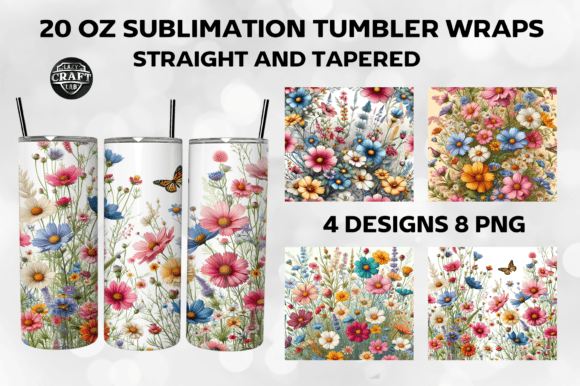
When I opened Wildflowers Tumbler Wraps 20oz Skinny, my eye went straight to the rhythm—not the flowers themselves, but how they move across the layout. It’s not a tight cluster or a centered monogram; it’s a gentle, asymmetrical sweep, with stems leaning just enough to suggest motion, petals opening like quiet breaths. This isn’t a design shouting for attention—it’s one that invites touch, pause, and personal connection. As an embroidery designer who’s stitched hundreds of client projects, I immediately saw its natural home: on a linen tea towel folded beside a farmhouse sink, a cotton apron worn by a local florist, or the curved front panel of a baby’s organic-cotton romper.
Where It Shines in Real Embroidery Projects
Wildflowers Tumbler Wraps 20oz Skinny translates beautifully to stitched texture—especially when treated as a machine embroidery design meant for soft, breathable fabrics. I tested a scaled-down version (about 3.5" wide) on a medium-weight cotton tote bag using a light tear-away stabilizer and 40-weight rayon thread. The result? Delicate but legible satin stitch petals held their shape, and the subtle variation in stem thickness gave dimension without overcrowding the fill stitch areas. It worked equally well on a relaxed-fit sweatshirt—no puckering, no thread breakage—because the design avoids extreme density or micro-detail that strains needles on knits.
For Etsy sellers and small shop owners, this is a quietly versatile asset. It layers thoughtfully into boutique branding: pair it with minimalist typography on a holiday embroidery kit, use it as the focal point on a personalized gift set (think embroidered pillow cover + matching kitchen towel), or adapt it for a seasonal craft fair collection—spring baby bundles, bridal shower favors, or floral-themed nursery decor. As a digital embroidery file, it holds up in printable mockups too; the clean outlines and open negative space make it easy to preview on light and dark fabric backgrounds without visual noise.
Where to Proceed with Intention
That said, Wildflowers Tumbler Wraps 20oz Skinny isn’t a “drop-in-and-stitch” solution for every surface. On highly textured fabrics—like bouclé knit or heavy terry cloth—the fine lines in the leaf veins can blur or disappear mid-stitch. On stretchy fabric, especially unlined caps or curved sleeves, the horizontal flow of the design may distort unless you use cut-away stabilizer and reduce tension slightly. And while the file is described as editable and resizable, I’d caution against shrinking it below 2.75" for embroidery: the smallest flower centers and petal edges risk becoming indistinct, especially on dark fabric where thread color contrast matters most.
It also doesn’t lend itself well to dense applique design workflows. There’s no built-in border or backing layer—so if you’re planning to stitch it as an embroidered patch, you’ll need to add your own satin-stitched edge or heat-seal backing manually. Likewise, avoid placing it near high-friction zones (like underarm seams or pocket hems) unless you’ve tested wash durability: delicate satin stitch holds up well *if* stabilized properly, but repeated abrasion will soften detail over time.
What It Adds—Beyond the Stitch
This is where Wildflowers Tumbler Wraps 20oz Skinny quietly elevates your finished product. It reads as handmade—not mass-produced. Customers notice that. When I used it on a set of custom embroidered tea towels for a local café, several guests asked, “Did you draw that yourself?” That kind of perceived authenticity builds trust, especially for craft businesses and Etsy sellers competing in a crowded handmade market. It also supports brand consistency: whether stitched on a baby onesie or a linen napkin, the design feels cohesive—not generic, not clip-art-y, but intentionally curated.
As a design asset, it encourages thoughtful pairing. Its organic flow works best alongside neutral thread colors (oatmeal, sage, dusty rose) rather than high-contrast neon or black-on-black combos. That restraint makes it ideal for personalized gifts where subtlety signals care—think graduation keepsakes, wedding guest favors, or new-parent welcome kits. It doesn’t dominate; it complements. And in commercial embroidery settings—say, stitching for a boutique’s private-label line—it adds quiet sophistication without requiring complex digitizing adjustments.
Practical Designer Notes Before You Stitch
- Always test Wildflowers Tumbler Wraps 20oz Skinny on scrap fabric first—especially if working with blends, knits, or dark substrates.
- Check thread color contrast early: run a black-and-white mockup to spot areas where detail might vanish on low-contrast backgrounds.
- Review stitch density visually—if the file includes fill stitch regions, ensure they’re not overly dense for lightweight fabrics.
- Confirm hoop size compatibility before loading: the original layout suggests a horizontal orientation, so verify your machine’s maximum hoop width.
- Inspect small details at actual stitch size—petal tips, stem junctions, and negative space between blooms—under magnification if needed.
- Use appropriate stabilizer: light tear-away for stable wovens, cut-away for knits or stretchy items, and water-soluble for delicate surfaces like silk or lace overlays.
- If selling finished products, verify licensing terms—this is a graphics file intended for sublimation on tumblers, but embroidery use may require separate permission depending on source.
Final Thought: A Design That Breathes With Your Work
Wildflowers Tumbler Wraps 20oz Skinny isn’t flashy—but it’s reliable, adaptable, and deeply considerate of how real people interact with handmade objects. It respects the fabric. It honors the stitch. And it gives your customers something they can hold, recognize, and remember—not just as decoration, but as intention made visible. For embroidery designers, craft business owners, and creative entrepreneurs building meaningful collections, that kind of quiet strength is rare. And worth every careful stitch.